
English title:
Governing Faculty–Generative AI Co-Creation of Learning Materials in Higher Education: The Mediating Role of Learning Material Quality in Teaching Effectiveness
NGUYỄN VĂN HÙNG
TÓM TẮT
Sự phát triển nhanh chóng của trí tuệ nhân tạo tạo sinh (Generative Artificial Intelligence – GenAI) đang tái cấu trúc quá trình thiết kế và phát triển học liệu trong giáo dục đại học. GenAI cho phép giảng viên tạo ý tưởng, cấu trúc bài học, ví dụ, tình huống, câu hỏi, bài tập, rubric và nội dung đa phương thức với tốc độ và khả năng thích ứng chưa từng có. Tuy nhiên, năng lực tạo sinh không đồng nghĩa với giá trị giáo dục. Nội dung do GenAI tạo ra có thể thiếu chính xác, không phù hợp với mục tiêu học tập, chứa thiên lệch, thiếu minh bạch hoặc không đáp ứng yêu cầu về đạo đức, quyền riêng tư và liêm chính học thuật. Bản thảo vì vậy chuyển trọng tâm nghiên cứu từ câu hỏi giảng viên “có sử dụng GenAI hay không” sang vấn đề quá trình đồng sáng tạo giảng viên–GenAI phải được quản trị như thế nào để tạo ra học liệu chất lượng và cải thiện hiệu quả giảng dạy.
Nghiên cứu đề xuất khái niệm Faculty–Generative AI Co-Creation Governance (FGACG), được định nghĩa là năng lực và hệ thống thực hành thông qua đó giảng viên chủ động cấu hình vai trò người–AI, điều phối tương tác đồng sáng tạo lặp lại, xác minh và biên tập đầu ra AI, bảo đảm liên kết sư phạm và thực thi các nguyên tắc AI có trách nhiệm trong toàn bộ vòng đời phát triển học liệu. FGACG được khái niệm hóa gồm năm cấu phần: Human–AI Role Configuration; Iterative Co-Creation; Human Verification & Editorial Control; Pedagogical Alignment; và Responsible AI Governance.
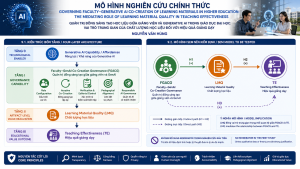
Trên nền tảng logic technological capability → governance/process capability → artifact-level value realization → educational outcome, nghiên cứu lập luận rằng GenAI chủ yếu cung cấp generative capability/affordances; FGACG quyết định cách năng lực này được chuyển hóa; Learning Material Quality (LMQ) phản ánh nơi giá trị được hiện thực hóa ở cấp độ artifact; và Teaching Effectiveness (TE) là kết quả giáo dục. Do đó, mô hình thực nghiệm trung tâm được xác lập là FGACG → LMQ → TE, trong đó LMQ đóng vai trò trung gian. Đường trực tiếp FGACG → TE được duy trì nhằm xác định bản chất của hiệu ứng trung gian. Thiết kế hỗn hợp tuần tự khám phá được đề xuất, kết hợp tổng quan tài liệu, nghiên cứu định tính, phát triển thang đo, pilot study, EFA/CFA, SEM và bootstrap mediation; dữ liệu đa thời điểm và đa nguồn được ưu tiên nhằm hạn chế common method bias.
Từ khóa: Trí tuệ nhân tạo tạo sinh (Generative AI); Đồng sáng tạo giữa con người và AI (Human–AI co-creation); Quản trị đồng sáng tạo giữa giảng viên và GenAI (Faculty–GenAI Co-Creation Governance); Chất lượng học liệu (Learning Material Quality); Hiệu quả giảng dạy (Teaching Effectiveness); AI có trách nhiệm (Responsible AI); Giám sát của con người (Human Oversight); Giáo dục đại học (Higher Education).

ABSTRACT
The rapid advancement of Generative Artificial Intelligence (GenAI) is reshaping the design and development of learning materials in higher education. GenAI enables faculty members to generate ideas, structure lessons, develop examples and cases, formulate questions and learning activities, construct assessment rubrics, and produce multimodal content with unprecedented speed and adaptability. However, generative capability does not inherently translate into educational value. GenAI-generated content may be inaccurate, misaligned with intended learning outcomes, biased, insufficiently transparent, or inconsistent with requirements concerning ethics, privacy, and academic integrity. Accordingly, this study shifts the analytical focus from whether faculty members use GenAI to how faculty–GenAI co-creation should be governed to produce high-quality learning materials and enhance teaching effectiveness.
This study introduces Faculty–Generative AI Co-Creation Governance (FGACG), defined as the capability and system of practices through which faculty members deliberately configure human–AI roles, orchestrate iterative co-creation, verify and editorially control AI-generated outputs, ensure pedagogical alignment, and operationalize responsible AI principles throughout the learning-material development lifecycle. FGACG is conceptualized as comprising five dimensions: Human–AI Role Configuration, Iterative Co-Creation, Human Verification and Editorial Control, Pedagogical Alignment, and Responsible AI Governance.
Building on the value-creation logic of technological capability → governance/process capability → artifact-level value realization → educational outcome, the study argues that GenAI primarily provides generative capabilities and affordances, whereas FGACG determines how these technological possibilities are transformed into educational value. Learning Material Quality (LMQ) represents the artifact-level locus at which such value is realized, while Teaching Effectiveness (TE) represents the educational outcome. The core empirical model is therefore specified as FGACG → LMQ → TE, with LMQ functioning as a mediator. The direct FGACG → TE pathway is retained to determine whether mediation is partial or full and to assess the extent to which governance capabilities may influence teaching effectiveness beyond improvements in learning-material quality.
An exploratory sequential mixed-methods design is proposed, integrating a literature review, qualitative inquiry, scale development, pilot testing, exploratory and confirmatory factor analyses (EFA/CFA), structural equation modeling (SEM), and bootstrap mediation analysis. Multi-wave and multi-source data collection is prioritized to mitigate common method bias and strengthen the validity of the proposed causal mechanism. By theorizing governance as the transformation mechanism between GenAI capabilities and educational outcomes, the study contributes a process-oriented explanation of how generative AI can be converted into pedagogically meaningful, trustworthy, and educationally valuable artifacts in higher education.
Keywords: Generative AI; Human–AI Co-Creation; Faculty–Generative AI Co-Creation Governance; Learning Material Quality; Teaching Effectiveness; Responsible AI; Human Oversight; Higher Education.
- GIỚI THIỆU
1.1. Từ khả năng tạo nội dung đến vấn đề tạo giá trị giáo dục
Sự phổ biến của GenAI tạo ra một thay đổi quan trọng trong hoạt động học thuật: chi phí biên của việc tạo nội dung giảm mạnh, trong khi tốc độ sản xuất và khả năng biến đổi nội dung tăng đáng kể. Đối với giảng viên đại học, GenAI có thể hỗ trợ từ giai đoạn hình thành ý tưởng đến thiết kế bài học, tạo tình huống, câu hỏi đánh giá, ví dụ, phản hồi và học liệu thích ứng.
Tuy nhiên, chính sự gia tăng mạnh của generation capability tạo ra một nghịch lý. Khi việc tạo nội dung trở nên dễ dàng hơn, thách thức trọng tâm không còn nằm ở khả năng sản xuất nội dung mà chuyển sang khả năng lựa chọn, kiểm chứng, điều chỉnh, tích hợp và chịu trách nhiệm đối với nội dung được tạo ra.
Vì vậy:
More generation does not necessarily mean more educational value.
Năng lực tạo sinh là điều kiện hỗ trợ, không phải điều kiện đủ để tạo ra kết quả giáo dục.
Đây là điểm xuất phát để nghiên cứu vượt khỏi cách tiếp cận dựa trên AI adoption, intention to use hoặc frequency of use. Bản thảo hiện tại cũng đã nhận diện khoảng trống này: các nghiên cứu về acceptance và AI literacy giải thích khá tốt tại sao giảng viên sử dụng AI nhưng chưa giải thích đầy đủ điều gì xảy ra sau adoption.
1.2. Vấn đề khoa học: “missing transformation mechanism”
Giữa GenAI capability và educational value tồn tại một quá trình chuyển hóa chưa được giải thích đầy đủ.
Một mô hình đơn giản:
GenAI use → Teaching Effectiveness
có nguy cơ rơi vào technological determinism: giả định rằng việc tiếp cận hoặc sử dụng công nghệ tự thân sẽ tạo ra kết quả tốt.
Nghiên cứu này thay thế logic đó bằng:
GenAI capability → governed co-creation → quality artifact → educational outcome.
Điều này dẫn đến ba câu hỏi sâu hơn:
Thứ nhất, điều gì quyết định một giảng viên chuyển năng lực tạo sinh của GenAI thành sản phẩm giáo dục đáng tin cậy?
Thứ hai, cơ chế gần (proximal mechanism) nào kết nối quản trị đồng sáng tạo với hiệu quả giảng dạy?
Thứ ba, FGACG cung cấp giá trị lý thuyết gia tăng nào so với AI use, AI literacy, technological competence hoặc pedagogical competence?
- LUẬN ĐỀ LÝ THUYẾT TRUNG TÂM
Phiên bản sau phản biện nên khóa luận đề:
Generative AI does not create educational value by generation alone. Educational value emerges when generative capabilities are deliberately governed through faculty–AI co-creation and transformed into pedagogically aligned, human-verified, responsible, and high-quality learning materials.
Luận đề này kế thừa nhưng làm sắc nét hơn central proposition của bản thảo hiện tại.
Từ đó hình thành chuỗi:
GenAI
↓
Generative capability/affordances
↓
FGACG
↓
Governance and transformation process
↓
LMQ
↓
Artifact-level value realization
↓
TE
Educational outcome
Điểm đặc biệt quan trọng là không nên đưa GenAI capability thành một latent predictor bắt buộc trong mô hình SEM chính, trừ khi nghiên cứu có thang đo và lý thuyết đủ mạnh. GenAI capability trước hết có thể đóng vai trò technological context/enabling condition của toàn bộ mô hình.
Như vậy, mô hình vừa giữ được tính gọn, vừa tránh over-modeling.
- NỀN TẢNG LÝ THUYẾT TÍCH HỢP
Thay vì sử dụng nhiều lý thuyết rời rạc, nghiên cứu nên xây dựng một integrative theoretical logic gồm bốn lớp.
Lớp 1 – Affordance perspective
GenAI cung cấp những khả năng hành động mới: generation, recombination, adaptation, personalization và multimodal production. Tuy nhiên, affordance chỉ thể hiện khả năng có thể được khai thác, không bảo đảm giá trị cuối cùng.
Lớp 2 – Human–AI collaboration/co-creation
Giá trị được hình thành thông qua tương tác giữa năng lực tạo sinh của AI với tri thức chuyên môn, phán đoán sư phạm và quyền quyết định của giảng viên.
Do đó:
AI generates; humans contextualize, evaluate, authorize, and remain accountable.
Lớp 3 – Governance perspective
Human–AI collaboration chưa đủ. Collaboration phải được governed.
Governance xác định ai thực hiện nhiệm vụ nào, quyết định nào không được giao cho AI, đầu ra được kiểm chứng ra sao, tiêu chuẩn sư phạm nào được áp dụng và trách nhiệm cuối cùng thuộc về ai.
Bản thảo đã xác định human oversight bao gồm accuracy, transparency, privacy, fairness và accountability, đồng thời đặt human oversight như thành phần cấu thành của governance thay vì một biến phụ trợ.
Lớp 4 – Artifact-mediated value creation
Đây là lớp cần được nhấn mạnh mạnh hơn sau phản biện.
Giữa một quy trình tốt và kết quả giáo dục phải tồn tại một đối tượng mang giá trị.
Trong nghiên cứu này, đối tượng đó là learning material.
Do đó:
LMQ is not merely another outcome; it is the artifact-level mechanism through which governed Human–AI co-creation becomes educationally consequential.
- FACULTY–GENERATIVE AI CO-CREATION GOVERNANCE
4.1. Định nghĩa chuẩn hóa
FGACG được định nghĩa:
Faculty–Generative AI Co-Creation Governance is the faculty capability and structured system of practices through which human and GenAI roles are configured, iterative co-creation is orchestrated, AI-generated outputs are verified and editorially controlled, pedagogical alignment is maintained, and responsible-AI principles are enforced throughout the learning-material development lifecycle.
Định nghĩa này mở rộng định nghĩa ban đầu của bản thảo, vốn đã nhấn mạnh role configuration, iterative co-creation, verification, pedagogical alignment và responsibility.
Điểm cốt lõi: FGACG không phải mức độ sử dụng GenAI.
- NĂM CẤU PHẦN CỦA FGACG
| Cấu phần | Nội hàm |
| Human–AI Role Configuration | Xác lập nhiệm vụ, thẩm quyền và giới hạn của AI và con người |
| Iterative Co-Creation | Đồng sáng tạo qua nhiều vòng tạo–đánh giá–phản hồi–hiệu chỉnh |
| Human Verification & Editorial Control | Kiểm chứng, biên tập và phê duyệt của giảng viên |
| Pedagogical Alignment | Liên kết nội dung với CLOs, hoạt động học tập, đánh giá và đặc điểm người học |
| Responsible AI Governance | Fairness, privacy, transparency, accountability, IP/integrity và human oversight |
Đặc biệt, Iterative Co-Creation phải vượt khỏi “prompt engineering”. Bản thảo đã mô hình hóa quá trình này thành:
Prompt → Generate → Evaluate → Feedback → Regenerate → Refine.
Đây là điểm phân biệt giữa AI-assisted content generation và governed Human–AI co-creation.
- PHÂN BIỆT KHÁI NIỆM VÀ GIÁ TRỊ LÝ THUYẾT GIA TĂNG
Đây nên trở thành một phần độc lập trong bài báo.
| Construct | Câu hỏi chính | Khác FGACG ở đâu? |
| AI adoption | Có chấp nhận AI không? | Adoption ≠ governance |
| AI use intensity | Sử dụng bao nhiêu? | Frequency ≠ quality of process |
| AI literacy | Có hiểu AI không? | Knowledge ≠ governance practice |
| Prompt competence | Có tương tác hiệu quả không? | Prompting chỉ là một phần |
| Pedagogical competence | Có năng lực sư phạm không? | Không đặc thù cho Human–GenAI governance |
| Human–AI collaboration | Người và AI có phối hợp không? | Collaboration không mặc nhiên bao gồm accountability/governance |
| FGACG | Quá trình đồng sáng tạo được quản trị thế nào? | Tích hợp role, iteration, verification, pedagogy và responsibility |
Đây là cơ sở cho incremental validity.
Nếu FGACG không giải thích thêm LMQ hoặc TE sau khi kiểm soát các construct gần, tính mới của construct sẽ yếu. Ngược lại, nếu ΔR² có ý nghĩa, bằng chứng về giá trị lý thuyết gia tăng sẽ mạnh hơn đáng kể.
- LEARNING MATERIAL QUALITY: CƠ CHẾ HIỆN THỰC HÓA GIÁ TRỊ
LMQ nên được khái niệm hóa như một multidimensional artifact-quality construct, gồm:
- Accuracy & Reliability;
- Pedagogical Alignment;
- Clarity & Cognitive Appropriateness;
- Relevance & Adaptability;
- Inclusiveness & Accessibility.
Đây cũng chính là năm chiều đã được xác định trong kiến trúc bản thảo.
Có thể cân nhắc Transparency & Integrity như chiều thứ sáu nếu nghiên cứu định tính và expert validation chứng minh nó thuộc miền nội dung của LMQ thay vì FGACG.
Cần tránh chồng lấn giữa Pedagogical Alignment của FGACG và pedagogical quality của LMQ:
- FGACG Pedagogical Alignment = process;
- LMQ Pedagogical Alignment = property of resulting artifact.
Đây là phân biệt rất quan trọng cho discriminant validity.
- TEACHING EFFECTIVENESS
TE là educational outcome, không phải thước đo tốc độ sản xuất học liệu.
Năm chiều có thể giữ:
Instructional Clarity – Student Engagement – Learning Facilitation – Adaptive Teaching – Instructional Efficiency.
Bản thảo hiện tại cũng cảnh báo không đồng nhất instructional efficiency với TE: tiết kiệm thời gian chỉ là lợi ích vận hành và chỉ trở thành giá trị giáo dục khi đi cùng chất lượng.
Vì vậy, các item như “GenAI giúp tôi tạo slide nhanh hơn” không nên được sử dụng trực tiếp để đo TE.
- MÔ HÌNH NGHIÊN CỨU CHÍNH THỨC
9.1. Kiến trúc bốn tầng
TẦNG 0 – TECHNOLOGICAL ENABLER
Generative AI Capability / Affordances
↓
TẦNG I – GOVERNANCE CAPABILITY
Faculty–GenAI Co-Creation Governance
Role Configuration
- Iterative Co-Creation
- Verification & Editorial Control
- Pedagogical Alignment
- Responsible AI Governance
↓
TẦNG II – ARTIFACT-LEVEL VALUE REALIZATION
Learning Material Quality
↓
TẦNG III – EDUCATIONAL VALUE OUTCOME
Teaching Effectiveness
9.2. Mô hình SEM nên kiểm định
FGACG → LMQ → TE
đồng thời:
FGACG → TE
Đây chính xác là mô hình cốt lõi bản thảo đã xác lập.
Không bổ sung moderator trong nghiên cứu đầu tiên, trừ khi dữ liệu định tính hoặc lý thuyết đưa ra lý do đủ mạnh.
- GIẢ THUYẾT NGHIÊN CỨU
H1 – FGACG → LMQ
Khi giảng viên phân vai người–AI rõ ràng, tiến hành nhiều vòng đồng sáng tạo, kiểm chứng đầu ra, bảo đảm liên kết sư phạm và áp dụng Responsible AI, xác suất chấp nhận nội dung chất lượng thấp giảm trong khi khả năng khai thác lợi thế của GenAI tăng.
H1: Faculty–Generative AI Co-Creation Governance positively influences Learning Material Quality.
Giả thuyết này nhất quán với quan hệ H1 hiện có trong bản thảo.
H2 – LMQ → TE
Học liệu chính xác, rõ ràng, phù hợp nhận thức, aligned và thích ứng cung cấp nền tảng để giảng viên tổ chức hoạt động dạy học tốt hơn.
H2: Learning Material Quality positively influences Teaching Effectiveness.
H3 – FGACG → TE
Governance có thể tạo tác động trực tiếp thông qua tăng reflection, intentional design và faculty quality-control capability.
H3: Faculty–Generative AI Co-Creation Governance positively influences Teaching Effectiveness.
H4 – Mediation
Đây phải được tuyên bố là central theoretical hypothesis.
H4: Learning Material Quality mediates the positive relationship between Faculty–Generative AI Co-Creation Governance and Teaching Effectiveness.
Logic không phải:
Good governance → automatically better teaching.
Mà là:
Good governance → better artifact → better teaching.
Bản thảo hiện tại cũng xác định LMQ là cơ chế “mở hộp đen” giữa governance và teaching outcome.
- KHÔNG NÊN CỐ ĐỊNH H5–H6 NHƯ HAI QUAN HỆ NHÂN QUẢ MỚI
Sau phản biện, tôi đề xuất không ép mô hình thành sáu giả thuyết cấu trúc chỉ để tăng độ phức tạp.
Thay vào đó, hai kiểm định bổ sung nên phục vụ construct validation:
H5 – Incremental validity: FGACG explains additional variance in LMQ beyond AI use intensity, AI literacy và relevant faculty competencies.
H6 – Measurement invariance: Measurement properties của FGACG được duy trì ở mức chấp nhận được giữa các nhóm quan trọng được xác định a priori.
Cách này mạnh hơn việc thêm moderator tùy ý.
- THIẾT KẾ NGHIÊN CỨU SAU PHẢN BIỆN
Bản thảo hiện đề xuất:
Literature Review → Qualitative Exploration → Scale Development → Pilot → EFA/CFA → SEM → Mediation → Governance Framework.
Tôi đề xuất chuẩn hóa thành 5 phases.
Phase I – Construct Domain Specification
Systematic/scoping literature review tập trung vào:
Human–AI collaboration; Human–AI co-creation; GenAI instructional design; learning material quality; Responsible AI; human oversight; teaching effectiveness.
Phase II – Qualitative Construct Development
Khoảng 20–30 knowledgeable participants, có thể gồm giảng viên có kinh nghiệm GenAI, chuyên gia instructional design, AI/EdTech và quản lý học thuật.
Mục tiêu không chỉ tạo item mà còn kiểm tra:
domain adequacy → construct boundaries → dimensions → item language → contextual relevance.
Phase III – Scale Development
Quy trình:
Item generation → expert review → content validity → cognitive interviews → pilot → item purification → EFA.
FGACG cần được kiểm tra xem phù hợp hơn với:
- correlated first-order model;
- second-order reflective model;
- hoặc composite/formative specification.
Không nên mặc định cấu trúc bậc hai trước dữ liệu.
Phase IV – Measurement Validation
Mẫu độc lập thứ hai:
CFA → reliability → convergent validity → discriminant validity → nomological validity → incremental validity.
Nên báo cáo:
ω, CR, AVE, HTMT và model fit.
Phase V – Structural Model
FGACG → LMQ → TE
Kiểm định indirect effect bằng bootstrap confidence intervals thay vì chỉ dựa vào Baron–Kenny logic.
- THIẾT KẾ MULTI-WAVE/MULTI-SOURCE
Đây là nâng cấp phương pháp quan trọng nhất.
Time 1 – Faculty
Đo:
FGACG; AI literacy; GenAI use intensity; demographic/professional controls.
Time 2 – Artifact
Thu học liệu thực tế do giảng viên phát triển.
LMQ nên được đánh giá bởi independent raters/expert rubric thay vì hoàn toàn self-report.
Time 3 – Students
Đo:
Teaching Effectiveness, instructional clarity, engagement/facilitation.
Như vậy:
Faculty → Artifact → Student
tương ứng trực tiếp với:
Governance → Material → Educational Outcome
Thiết kế đo lường và lý thuyết lúc này trở nên đồng cấu (isomorphic), giúp lập luận nhân quả thuyết phục hơn đáng kể.
- COMMON METHOD BIAS
Không nên chỉ dùng Harman’s single-factor test.
Biện pháp mạnh nhất là procedural separation:
- temporal separation;
- source separation;
- psychological separation;
- anonymity;
- neutral wording;
- independent artifact assessment.
Bản thảo vốn đã định hướng multi-source/multi-wave để giảm common method bias; phiên bản cuối nên nâng nguyên tắc này thành thành phần cốt lõi của research design.
- SEM PROTOCOL CHUẨN HÓA
Quy trình phân tích nên khóa:
Data screening
↓
EFA – Scale Development Sample
↓
CFA – Validation Sample
↓
Reliability
↓
Convergent Validity
↓
Discriminant Validity
↓
Competing Measurement Models
↓
Structural Model
↓
Direct Effects
↓
Bootstrap Indirect Effect
↓
Incremental Validity
↓
Robustness Tests
↓
Measurement Invariance
Điểm quan trọng là so sánh:
Model A: FGACG → TE
với
Model B: FGACG → LMQ → TE
Nếu Model B giải thích dữ liệu tốt hơn và indirect effect đáng kể, nghiên cứu có bằng chứng trực tiếp cho artifact-mediated value-creation mechanism.
- MA TRẬN VẬN HÀNH HÓA
| Construct | Level | Source ưu tiên | Bản chất |
| GenAI capability | Technology/context | Contextual | Enabler |
| FGACG | Faculty/process | Faculty | Governance capability |
| LMQ | Artifact | Expert/independent raters | Value realization |
| TE | Educational practice | Students + faculty/other evidence | Outcome |
| AI literacy | Faculty | Faculty | Control |
| GenAI use intensity | Faculty | Faculty | Control |
Ma trận này giải quyết một vấn đề thường gặp của nghiên cứu AI giáo dục: predictor, mediator và outcome không còn được một người tự đánh giá trong cùng một bảng hỏi.
- ĐÓNG GÓP LÝ THUYẾT
Nghiên cứu có thể tuyên bố bốn đóng góp, phù hợp với bốn tầng novelty mà bản thảo ban đầu đã nhận diện.
Thứ nhất – Construct contribution. Phát triển FGACG như một construct khác biệt với AI adoption, AI literacy và generic Human–AI collaboration.
Thứ hai – Process contribution. Chuyển nghiên cứu từ “whether faculty use GenAI” sang “how GenAI-mediated co-creation is governed”.
Thứ ba – Mechanism contribution. Xác lập LMQ như cơ chế trung gian ở cấp artifact:
Governance → Artifact Quality → Educational Outcome.
Thứ tư – Measurement contribution. Phát triển và kiểm định thang đo FGACG thay vì tiếp tục sử dụng frequency/intention-to-use như proxy cho chất lượng tích hợp AI.
- ĐÓNG GÓP THỰC TIỄN
Kết quả nghiên cứu có thể chuyển thành FGACG Governance Framework cho đại học.
Thay vì hướng dẫn:
“Hãy sử dụng GenAI để tạo học liệu.”
khung quản trị sẽ yêu cầu:
Define roles → Co-create iteratively → Verify → Pedagogically align → Govern responsibly → Evaluate artifact → Deploy → Review.
Điều này chuyển chính sách AI của trường từ tool-centric governance sang educational-value governance.
- RESPONSIBLE AI GOVERNANCE LÀ THÀNH PHẦN CẤU THÀNH, KHÔNG PHẢI PHỤ LỤC
Một điểm cần khóa sau phản biện là Responsible AI không nên đặt ở cuối bài như “ethical implications”.
Nó nằm bên trong FGACG.
Các nguyên tắc cốt lõi gồm:
Accuracy – Fairness – Transparency – Privacy – Accountability – Human Oversight – Academic Integrity/IP.
Bản thảo đã đặt accuracy, transparency, privacy, fairness, accountability và human oversight vào logic governance.
Điều này có ý nghĩa lý thuyết: một quy trình có hiệu suất cao nhưng thiếu accountability hoặc human oversight không thể được đánh giá là FGACG cao.
- KẾT LUẬN CHUẨN HÓA SAU PHẢN BIỆN
Nghiên cứu này không bắt đầu từ giả định rằng GenAI tự động nâng cao chất lượng giáo dục. Trái lại, nó đặt vấn đề ở cơ chế chuyển hóa giá trị.
GenAI có thể tạo ra nội dung, nhưng không tự xác định mục tiêu giáo dục, không tự bảo đảm tính phù hợp sư phạm và không thể thay thế trách nhiệm học thuật cuối cùng của giảng viên.
Vì vậy, chuỗi lý thuyết được xác lập:
GenAI provides generative capability.
FGACG governs its transformation into educational artifacts.
LMQ represents artifact-level value realization.
TE represents educational value realization.
Hay cô đọng:
Capability → Governance → Artifact Value → Educational Outcome
Mô hình thực nghiệm trung tâm vì thế phải giữ ở dạng:
FGACG → LMQ → TE
với FGACG → TE được giữ để kiểm định direct effect và bản chất mediation.
Cấu trúc này phù hợp với mô hình cốt lõi và định hướng novelty đã có trong bản thảo. Đồng thời, nó đưa nghiên cứu vượt khỏi câu hỏi tương đối đơn giản về việc GenAI có hỗ trợ giảng viên hay không để giải quyết câu hỏi có giá trị lý thuyết cao hơn:
Under what governance mechanism can the generative capabilities of AI be transformed into high-quality educational artifacts and, ultimately, improved teaching effectiveness?
Đây nên được xem là research question trung tâm và “intellectual signature” của phiên bản 25–30 trang.
Công thức cuối cùng nên khóa
TECHNOLOGICAL ENABLER
GenAI Generative Capability/Affordances
↓
TRANSFORMATION GOVERNANCE
Faculty–GenAI Co-Creation Governance (FGACG)
Role Configuration + Iterative Co-Creation + Human Verification & Editorial Control + Pedagogical Alignment + Responsible AI Governance
↓
ARTIFACT-LEVEL VALUE REALIZATION
Learning Material Quality (LMQ)
↓
EDUCATIONAL VALUE OUTCOME
Teaching Effectiveness (TE)
Với kiến trúc này, điểm mới không còn là tuyên bố “GenAI giúp tạo học liệu tốt hơn”, mà là phát triển và kiểm định một lý thuyết về cách năng lực tạo sinh của AI được quản trị, chuyển hóa và hiện thực hóa thành giá trị giáo dục thông qua artifact. Đây là hướng định vị mạnh hơn đáng kể cho bản thảo sau phản biện và cũng tạo nền tảng nhất quán cho phát triển thang đo FGACG, kiểm định mediation, incremental validity, multi-source/multi-wave design và measurement invariance.
TÀI LIỆU THAM KHẢO TRỌNG TÂM — APA 7
- Amershi, S., Weld, D., Vorvoreanu, M., Fourney, A., Nushi, B., Collisson, P., Suh, J., Iqbal, S., Bennett, P. N., Inkpen, K., Teevan, J., Kikin-Gil, R., & Horvitz, E. (2019). Guidelines for human-AI interaction. In Proceedings of the 2019 CHI Conference on Human Factors in Computing Systems (pp. 1–13). Association for Computing Machinery. https://doi.org/10.1145/3290605.3300233
- Anderson, J. C., & Gerbing, D. W. (1988). Structural equation modeling in practice: A review and recommended two-step approach. Psychological Bulletin, 103(3), 411–423. https://doi.org/10.1037/0033-2909.103.3.411
- Biggs, J. (1996). Enhancing teaching through constructive alignment. Higher Education, 32(3), 347–364. https://doi.org/10.1007/BF00138871
- Boateng, G. O., Neilands, T. B., Frongillo, E. A., Melgar-Quiñonez, H. R., & Young, S. L. (2018). Best practices for developing and validating scales for health, social, and behavioral research: A primer. Frontiers in Public Health, 6, Article 149. https://doi.org/10.3389/fpubh.2018.00149
- Bond, M., Khosravi, H., De Laat, M., Bergdahl, N., Negrea, V., Oxley, E., Pham, P., Chong, S. W., & Siemens, G. (2024). A meta systematic review of artificial intelligence in higher education: A call for increased ethics, collaboration, and rigour. International Journal of Educational Technology in Higher Education, 21, Article 4. https://doi.org/10.1186/s41239-023-00436-z
- Chiu, T. K. F. (2024). Future research recommendations for transforming higher education with generative AI. Computers and Education: Artificial Intelligence, 6, 100197. https://doi.org/10.1016/j.caeai.2023.100197
- Crompton, H., & Burke, D. (2023). Artificial intelligence in higher education: The state of the field. International Journal of Educational Technology in Higher Education, 20, Article 22. https://doi.org/10.1186/s41239-023-00392-8
- Dellermann, D., Ebel, P., Söllner, M., & Leimeister, J. M. (2019). Hybrid intelligence. Business & Information Systems Engineering, 61(5), 637–643. https://doi.org/10.1007/s12599-019-00595-2
- DeVellis, R. F., & Thorpe, C. T. (2021). Scale development: Theory and applications (5th ed.). SAGE Publications.
- Fu, X., & Zhang, L. J. (2026). Integrating GenAI into EAP course materials design: A case study of the “English academic writing in the digital environment” course. Journal of English for Academic Purposes, 83, 101752. https://doi.org/10.1016/j.jeap.2026.101752
- Hair, J. F., Black, W. C., Babin, B. J., & Anderson, R. E. (2019). Multivariate data analysis (8th ed.). Cengage.
- Hayes, A. F. (2022). Introduction to mediation, moderation, and conditional process analysis: A regression-based approach (3rd ed.). Guilford Press.
- Henseler, J., Ringle, C. M., & Sarstedt, M. (2015). A new criterion for assessing discriminant validity in variance-based structural equation modeling. Journal of the Academy of Marketing Science, 43(1), 115–135. https://doi.org/10.1007/s11747-014-0403-8
- Jarrahi, M. H. (2018). Artificial intelligence and the future of work: Human-AI symbiosis in organizational decision making. Business Horizons, 61(4), 577–586. https://doi.org/10.1016/j.bushor.2018.03.007
- Kasneci, E., Sessler, K., Küchemann, S., Bannert, M., Dementieva, D., Fischer, F., Gasser, U., Groh, G., Günnemann, S., Hüllermeier, E., Krusche, S., Kutyniok, G., Michaeli, T., Nerdel, C., Pfeffer, J., Poquet, O., Sailer, M., Schmidt, A., Seidel, T., … Kasneci, G. (2023). ChatGPT for good? On opportunities and challenges of large language models for education. Learning and Individual Differences, 103, 102274. https://doi.org/10.1016/j.lindif.2023.102274
- Lim, W. M., Gunasekara, A., Pallant, J. L., Pallant, J. I., & Pechenkina, E. (2023). Generative AI and the future of education: Ragnarök or reformation? A paradoxical perspective from management educators. The International Journal of Management Education, 21(2), 100790. https://doi.org/10.1016/j.ijme.2023.100790
- Mayer, R. E. (2021). Multimedia learning (3rd ed.). Cambridge University Press. https://doi.org/10.1017/9781316941355
- Mishra, P., & Koehler, M. J. (2006). Technological pedagogical content knowledge: A framework for teacher knowledge. Teachers College Record, 108(6), 1017–1054. https://doi.org/10.1111/j.1467-9620.2006.00684.x
- National Institute of Standards and Technology. (2023). Artificial intelligence risk management framework (AI RMF 1.0) (NIST AI 100-1). U.S. Department of Commerce. https://doi.org/10.6028/NIST.AI.100-1
- National Institute of Standards and Technology. (2024). Artificial intelligence risk management framework: Generative artificial intelligence profile (NIST AI 600-1). U.S. Department of Commerce. https://doi.org/10.6028/NIST.AI.600-1
- Nguyễn, V. H. (Chủ biên). (2026). Công nghệ giáo dục thông minh trong kỷ nguyên AI: Educational technology in the age of artificial intelligence(Tập 1). AITECHBOOK.
- Nguyễn, V. H. (Chủ biên). (2026). Công nghệ giáo dục thông minh trong kỷ nguyên AI: Educational technology in the age of artificial intelligence(Tập 2). AITECHBOOK.
- Podsakoff, P. M., MacKenzie, S. B., Lee, J.-Y., & Podsakoff, N. P. (2003). Common method biases in behavioral research: A critical review of the literature and recommended remedies. Journal of Applied Psychology, 88(5), 879–903. https://doi.org/10.1037/0021-9010.88.5.879
- Ren, R., Ma, J., & Luo, J. (2026). Human-AI co-creation: Why, what, and how? Proceedings of the Design Society, 6, 2503–2510. https://doi.org/10.1017/pds.2026.10608
- Seeber, I., Bittner, E., Briggs, R. O., de Vreede, T., de Vreede, G.-J., Elkins, A., Maier, R., Merz, A. B., Oeste-Reiß, S., Randrup, N., Schwabe, G., & Söllner, M. (2020). Machines as teammates: A research agenda on AI in team collaboration. Information & Management, 57(2), 103174. https://doi.org/10.1016/j.im.2019.103174
- Shi, L. (2025). Assessing teachers’ generative artificial intelligence competencies: Instrument development and validation. Education and Information Technologies, 30, 23365–23384. https://doi.org/10.1007/s10639-025-13684-5
- Spooren, P., Brockx, B., & Mortelmans, D. (2013). On the validity of student evaluation of teaching: The state of the art. Review of Educational Research, 83(4), 598–642. https://doi.org/10.3102/0034654313496870
- (2023). Guidance for generative AI in education and research. UNESCO.
- (2024). AI competency framework for teachers. UNESCO.
- Vargo, S. L., & Lusch, R. F. (2004). Evolving to a new dominant logic for marketing. Journal of Marketing, 68(1), 1–17. https://doi.org/10.1509/jmkg.68.1.1.24036
- Wang, P., Jing, Y., & Shen, S. (2025). A systematic literature review on the application of generative artificial intelligence (GAI) in teaching within higher education: Instructional contexts, process, and strategies. The Internet and Higher Education, 65, 100996. https://doi.org/10.1016/j.iheduc.2025.100996
- Xia, Q., Yang, Y., Weng, X., Cilsalar-Sagnak, H., Cheng, W. K., & Chiu, T. K. F. (2026). Generative artificial intelligence competency self-efficacy scale for teachers and researchers (GAICS-TR) in higher education. Journal of Computers in Education, 13, 769–793. https://doi.org/10.1007/s40692-025-00373-y
